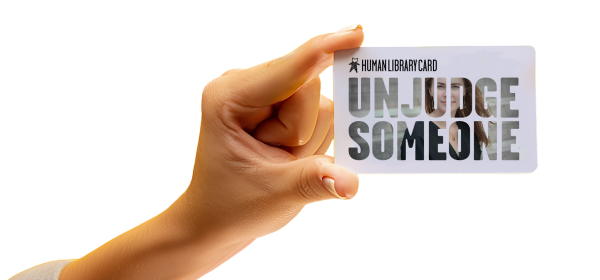

Checking Out a Human Being
I was watching CBS Sunday Morning recently when a segment about something called the Human Library immediately grabbed my attention. The concept is exactly what it sounds like.
Instead of checking out books, people “check out” human beings for conversations that typically last about 30 minutes. Founded more than 25 years ago in Copenhagen, Denmark, the Human Library now operates in more than 80 countries through events hosted at libraries, museums, festivals, universities and community spaces around the world.
The goal is simple: replace assumptions with conversations.
The “human books” are volunteers willing to openly share parts of their lives and experiences that are often misunderstood by others. Readers are encouraged to ask respectful questions they might otherwise never feel comfortable asking.
Imagine sitting down for half an hour with: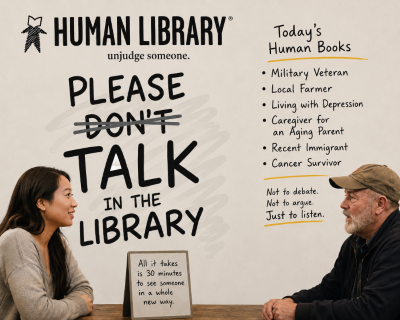
- a military veteran
- someone living with a mental health challenge
- a local farmer
- a caregiver for an aging parent
- a recent immigrant building a new life
- a cancer survivor
Not to debate them. Not to persuade them. Not to prove a point. Just to listen. And the more I thought about it, the more timely the idea felt.
Maybe it resonated with me because of the work I do. In communications, we're constantly thinking about how to connect with people from different backgrounds, experiences and perspectives. The challenge isn't simply crafting a message. It's understanding the audience receiving it.
The Human Library flips that equation. Instead of focusing on what we want to say, it encourages us to focus on what we might learn by listening.
Today, many of us believe we know people because we've seen fragments of their lives online. A social media post. A headline. A comment section. A meme. An opinion. Algorithms quietly feed us more of what we already agree with and, too often, reinforce assumptions about people we've never actually met.
We increasingly encounter one another as categories instead of human beings. The Human Library turns that upside down. It asks people to slow down long enough to have a real conversation with someone they may have otherwise reduced to a label. And often, what they discover is complexity, vulnerability, humor, resilience and humanity that simply cannot come through on a screen.
What struck me most is that the Human Library isn't built around persuasion. The point isn’t to change someone's politics, religion or worldview. It's simply to create understanding through conversation, something that feels increasingly rare in a culture where so much interaction happens through keyboards and comment threads.
Books have always allowed readers to step into someone else's life for a little while. The Human Library simply removes the paper.
And the more I think about it, the more I wonder what might happen if we created something similar right here in Martin County. What might happen if strangers sat down together for thirty minutes not to persuade one another, but simply to understand one another a little better? Maybe we'd discover we have more in common than we think.
Maybe Martin County needs a Human Library. What are your thoughts? Email me at stacy@fireflyforyou.com.