

When the First Story Isn’t the Whole Story
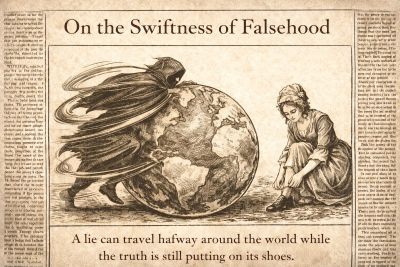
“A lie can travel halfway around the world while the truth is still putting on its shoes.” I’ve always loved that quote. Long before social media made it feel like a daily reality. Now it can circle the world in an instant … a hundred thousand times over.
One post. One comment. One confident statement that sounds like it *could* be true, and suddenly it’s everywhere. People reacting to it, repeating it, building on it.
Meanwhile, the truth is still trying to catch up.
We were recently engaged on a complex project here in South Florida. Like many in the community, we initially had questions. Some skepticism. Some uncertainty about what we were hearing and reading.
So we did what we always do.
 We started digging and educating ourselves. We talked to the engineers. The planners. The technical experts. We asked a lot of questions. And we kept asking until we understood it.
And after many weeks of what felt like drinking from a fire hose of information, one thing became clear.
Nearly every concern being raised had a clear, factual answer.
Not a spin. Not a talking point. An actual answer.
In many cases, the issue was already being addressed. In some cases, it was never an issue to begin with once you understand what’s really being proposed.
To be fair, many of those concerns came from a very real place where people were trying to make sense of something complex with limited information. That doesn’t mean people shouldn’t have questions.
But it does make you stop and think.
Why is our first instinct to believe information that alarms us instead of digging further?
Why does the first version of a story stick so hard?
Why are we so quick to assume the worst?
Because once that mindset sets in, everything that follows gets filtered through it.
Facts get dismissed. Explanations get cut off. The people providing information are viewed with suspicion. And what started as curiosity about something, turns into false certainly.
It means some people have already decided the professionals involved must be wrong. Or worse, that they must be lying. The idea that people whose reputations depend on getting this right would knowingly put out false information doesn’t align with how these teams operate. And yet, for some, it’s where they start.
Somewhere along the way, we’ve lost the middle ground. It’s either full belief or blind distrust. Not much room left for asking questions and actually listening to the answers.
And in that gap, misinformation wins.
Not because it’s better. Because it’s easier.
The truth usually asks more of us. It comes with context, details and things that don’t fit neatly into a headline or a comment thread. It comes with integrity and authenticity.
So people impatiently move on. And the first version becomes the lasting one.
In our work, that means slowing things down when everything around us is speeding up. Going back to the facts. Explaining them clearly – in plain language. Without jargon. Repeating them when necessary.
And sometimes, accepting that no matter how clearly you explain something, some people have already made up their minds.
That’s the hard part. Because the truth doesn’t just take longer.
Sometimes, it shows up to an audience that’s no longer listening.
So maybe the question isn’t why misinformation spreads.
Maybe it’s this: are we still willing to do the work to really understand something…or have we gotten comfortable believing whatever gets there first?
Have you found yourself in this situation before? Drop me an email at stacy@fireflyforyou.com and share your story with me. I’d love to hear it.